
The Room Isn’t Too Small. Your Furniture Might Be.


Have you ever walked into a room and immediately thought, There is no way my furniture is going to fit in here?
Sometimes the room really is small.
But sometimes? The room isn’t the problem. The furniture is.
One of the most overlooked parts of both home staging and interior design is scale. The size of the furniture you put into a room, and where you put it, can completely change how that space feels.
A perfectly good living room can suddenly feel cramped because the sofa is too deep. An open-concept great room can feel confusing because the furniture isn't defining the different areas. And an empty room? That can be surprisingly difficult to judge at all.
This is why staging isn't simply about making a home look pretty. Good staging helps buyers understand the space.
Bigger Isn't Always Better
We love a giant sectional as much as anyone, but not every living room was built for one.
Oversized sofas, deep chairs, bulky recliners and large end tables can quickly eat up usable floor space. Even when everything technically fits, the room can still feel smaller because there isn't enough visual or physical space around the furniture.
When we're staging, we look at more than whether a sofa will fit against a wall. We consider how deep it is, how much visual weight it carries, what other pieces need to share the room and, most importantly, how people will move through the space.
Sometimes taking just a few inches off the depth of a sofa or choosing a chair with a more open profile makes a surprisingly big difference.
But Tiny Furniture Isn't the Answer Either
Here's where things get tricky.
If oversized furniture makes a room feel small, it seems logical that smaller furniture would make it feel bigger. Not necessarily.
Furniture that is too small for a room can make the space feel awkward and actually draw attention to its proportions. A tiny rug floating in the middle of a large living room or a petite sofa on a long wall doesn't make the room look spacious. It makes the furniture look undersized.
The goal is proportion.
Furniture should feel appropriate for the architecture and dimensions of the room. Large spaces need enough visual weight to feel grounded. Smaller spaces need pieces that provide function without swallowing up valuable floor space.
It's a balancing act, and getting that balance right is one of the things professional staging can completely change.
Furniture Should Show Buyers How the Room Works
Scale is only part of the equation. Placement matters just as much.
We recently staged a home in Waverly with a beautiful great room that wasn't necessarily easy to understand when empty. Several functions needed to happen within one open space, and the living area itself felt smaller than buyers might expect.
Instead of trying to squeeze in as much furniture as possible, we used appropriately scaled pieces and intentional placement to create clear areas for living, dining and gathering.
Suddenly, the space made sense.
That's one of my favorite things about staging an awkward floor plan. We're not changing walls or adding square footage. We're showing buyers how to use what is already there.
Don't Forget the Walkways
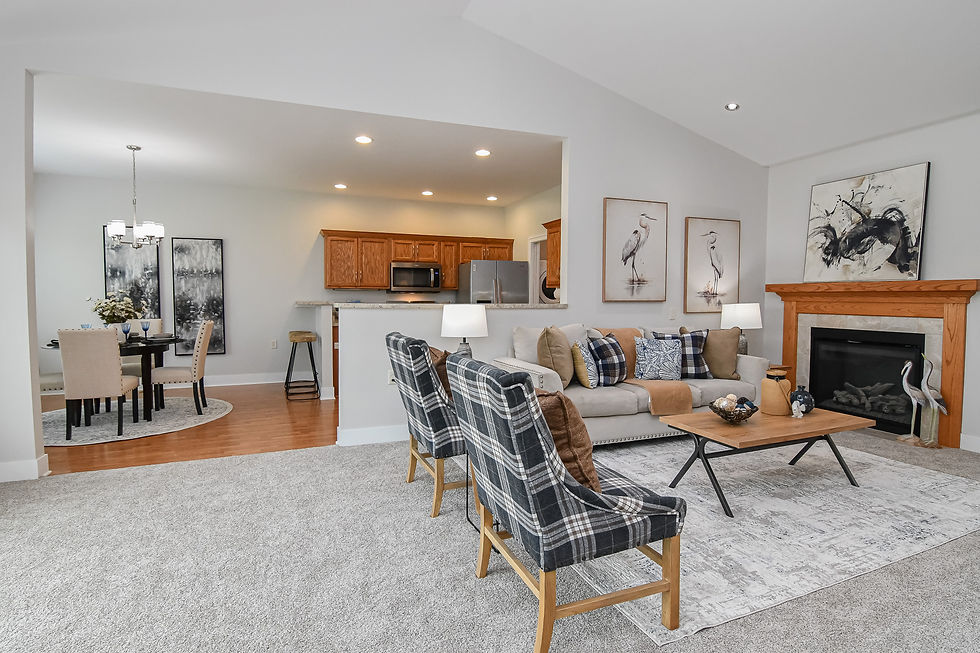
One of the easiest ways to make a room feel cramped has nothing to do with its actual size.
It's how you move through it.
If you have to squeeze between the sofa and coffee table, walk around the corner of a dining table or navigate an obstacle course of accent chairs to get across the room, the space is going to feel tight.
Good space planning creates natural pathways through a room. You shouldn't have to consciously think about how to get from Point A to Point B.
We recently saw this become especially important while staging a senior living rental townhome at Glenwood Place in Marshalltown. Because prospective residents needed to be able to comfortably navigate the home, we were particularly intentional about maintaining wider walkways and open paths.
The result wasn't just more functional. The rooms also felt more spacious, comfortable and welcoming.
And that's a principle that applies to every home, regardless of who lives there.
The Right Furniture Can Actually Make an Empty Room Feel Bigger
This one surprises people.
Sellers sometimes assume leaving a room empty will make it appear larger because there is nothing taking up floor space.
In reality, an empty room gives buyers very little context for scale.
Without a sofa, bed or dining table as a visual reference, it can be difficult to tell how large a room actually is. Buyers may look at an empty bedroom and wonder whether a king-size bed will fit. They may see a vacant living room and assume there isn't enough space for a sofa and chairs.
The right furniture answers those questions before buyers have to ask them.
It gives their eyes a reference point and demonstrates what comfortably fits while still leaving room to move.
That's why a properly staged room can sometimes feel larger furnished than it did completely empty.
Your Furniture Might Work in Your Home, But Not for Selling It
This is an important distinction.
The way we live in our homes and the way we market them aren't always the same.
Maybe your oversized sectional is incredibly comfortable for family movie nights. Maybe you need three recliners because everyone has a favorite seat. Maybe that extra cabinet stores something you use every single day. None of that makes those choices wrong.
But when you're preparing a home for sale, the goal changes. Instead of designing around your family's daily routine, we're creating a space that communicates clearly to buyers.
That may mean removing a piece, rearranging a layout or temporarily replacing furniture with something better scaled to showcase the room.
We're not trying to convince buyers that our furniture is beautiful.
We're using furniture to prove that the room works.
Good Staging Is Really Good Space Planning

The prettiest pillow in the world can't fix a bad furniture layout.
Accessories, artwork and styling absolutely matter, especially when we're creating the finished look that photographs beautifully and makes a home feel inviting. But the foundation comes first.
Scale. Proportion. Function. Flow.
When those pieces are right, the room feels effortless. Buyers don't necessarily walk in thinking, Wow, what excellent space planning.
They simply understand the home.
They can see where the sofa goes. They know the dining table fits. They can picture walking through the room, entertaining friends or settling in at the end of the day.
And that's exactly what good staging is supposed to do.
At Staging 2 Sell It, we stage homes throughout Iowa with more than aesthetics in mind. Every furniture selection and layout is chosen to highlight the home's architecture, improve flow and help buyers understand how each space can function.
Because sometimes you don't need a bigger room.
You just need the right furniture in it.
Not sure if your furniture is helping or hurting your space?
Whether you're preparing to sell or simply struggling with the way a room functions, a fresh set of eyes can make all the difference. Staging 2 Sell It offers professional home staging and interior design services, based in Central Iowa and serving clients throughout the state. We also offer virtual interior design services for clients near and far.
Ready to see what your space could be? Let's talk.


Comments